Skip to content
Meta Description: Why does flexo color drift? It’s not the ink or the operator. It’s the math: anilox BCM, LPI, doctor blade and roller material. The 3 locks of flexo color stability, explained.
Ask any flexo printing operator about the most frustrating problem on the floor, and “color drift” is near the top of the list. The first color prints perfectly. By the middle of the roll, it’s off. The operator adjusts the blade pressure, tweaks the ink, slows down the press — and still, the color wanders.
Most blame the ink. Some blame the operator. Few look at the real cause: in flexo printing, ink transfer is a mathematical process, not a matter of feel. The amount of ink that lands on your substrate is decided by a chain of precisely controlled variables — and when any one of them drifts, your color drifts with it.
This guide explains the three “locks” that hold flexo ink transfer stable: the anilox roller’s BCM, the doctor blade system, and the roller material. Understand these, and you’ll understand why color drifts — and how to stop it.

1. The First Lock: Anilox BCM — Flexo’s Ink Metering Heart
In flexo printing, the anilox roller is not an “ink roller” in the traditional sense. It is a metering device — the component that decides exactly how much ink transfers to the plate, and from the plate to the substrate.
The key specification is BCM (Billion Cubic Microns per square inch) — the total volume of all the tiny cells engraved on the anilox surface. Think of it as a set of microscopic measuring cups: each cell holds a precise volume of ink, and each revolution of the roller transfers exactly what the cells carry.
The flexo ink transfer equation:
Ink transfer = BCM × roller revolutions × transfer efficiency
This is why flexo printing is fundamentally different from offset (which meters ink with key zones) or gravure (which relies on blade depth). Flexo meters ink by cell volume — and that volume is a number you choose when you select the anilox roller.
The practical consequence: if your BCM is wrong for the job, no amount of blade pressure or ink adjustment will give you the right color. The metering is locked at the roller — before the ink ever touches the plate.
2. Flexo LPI: The Anilox Line Count — and the Confusion That Trips Everyone
BCM’s partner is LPI (Lines Per Inch) — the count of cells across one inch of the anilox roller surface. This is the “fineness” of the anilox screen.
Here’s where a common confusion happens. Many printers mix up two different “LPI” numbers:
| Concept | Typical Range in Flexo | What It Controls |
|---|---|---|
| Anilox LPI (cell count) | 360–1,400 LPI (narrow/wide web) | How fine the anilox cells are |
| Plate screen ruling | 85–200 LPI | The halftone dot density on the plate |
The anilox LPI is not the same as the plate’s screen ruling. The anilox roller must be much finer than the plate screen — industry practice (per FTA guidance) is roughly 3–6 times finer. If the anilox LPI is too coarse, the plate dots sink into the cells without enough wall support, causing dot gain and dirty printing.
The rule of thumb: plate screen of 100 LPI → anilox around 400–600 LPI. Plate screen of 150 LPI → anilox around 600–1,000+ LPI.

3. Pairing BCM and LPI: Matching the Roller to the Job
BCM and LPI work as a pair, and they trade off against each other:
Higher LPI = smaller cells = lower BCM (less ink)
Lower LPI = larger cells = higher BCM (more ink)
This is why you cannot pick an anilox roller by LPI alone — you must match both numbers to your printing application.
| Flexo Application | Typical Anilox LPI | Typical BCM | Why |
|---|---|---|---|
| Fine process / high-end graphics | 800–1,200+ | 1.5–3.5 | Small cells, thin ink film, detail retention |
| Standard color packaging | 550–800 | 3.0–5.5 | Balance of detail and density |
| General text & line work | 400–550 | 5.5–9.0 | More ink for solid coverage |
| Heavy solids / white ink | 200–400 | 9.0–15+ | Large cells, thick ink film, opacity |
| Coating / varnish | 100–200 | 15–30 | Maximum volume |
The flexo selection error we see most often: picking a roller for “general use” and expecting it to handle both fine process work and heavy solids. It can’t — the BCM/LPI pair is application-specific. Pick the wrong pair, and no blade pressure adjustment will save you.
4. The Second Lock: The Doctor Blade — Turning a Variable into a Constant
Once the anilox roller meters the ink, the doctor blade is supposed to remove the excess — leaving only the ink inside the cells. But not all doctor blade systems do this equally.
The Open Doctor Blade Problem
With an open (conventional) doctor blade, the ink film on the roller surface is controlled by blade pressure. And pressure is a variable:
- Operator adjusts pressure → ink film thickness changes → transfer changes → color changes
- Blade wears → effective pressure changes → color drifts over the run
- Vibration at high speed → pressure fluctuates → color wavers
Pressure is a variable, and variables are unstable. On an open blade system, your ink volume is never truly locked.
The Enclosed Chamber Blade Solution
An enclosed chamber doctor blade changes the physics:
- The ink is sealed inside a chamber around the roller
- The blade’s only job is to level the ink film flush with the cell walls
- The ink volume is determined by the cell volume (BCM), not by blade pressure
Transfer goes from feel-based to volume-based. The blade no longer decides how much ink; it simply confirms what the anilox cells already carry. This is the second lock on flexo color stability — and it’s why enclosed chamber blades are standard on professional flexo presses.

5. The Third Lock: Ceramic Anilox — Keeping the BCM Honest
You’ve selected the right BCM, matched the right LPI, and installed an enclosed chamber blade. There’s one more thing that can silently destroy your color: the anilox roller itself wearing down.
The Steel Roller Problem
A steel (chrome-plated) anilox roller wears under the constant friction of the doctor blade. As the cells erode:
- Cell geometry changes → BCM changes → ink volume changes → color drifts
- The wear is gradual, so it’s hard to notice until the color is visibly wrong
- Re-engraving or replacement becomes a recurring cost
The BCM you started with is not the BCM you have six months later.
The Ceramic Anilox Advantage
A ceramic anilox roller holds its cell geometry far longer:
- Higher hardness resists blade wear
- Cell shape stays consistent over tens of thousands of meters
- Ink transfer stays consistent — roll after roll, month after month
This is why ceramic anilox is the professional standard in flexo: it keeps the “mathematical lock” on ink volume honest over the long run.
6. The Three Locks Together: Why They Belong on Every Flexo Press
| Lock | What It Does | What Happens Without It |
|---|---|---|
| BCM metering | Locks ink volume at the roller | Color wrong from the start, untunable |
| Enclosed chamber blade | Removes pressure as a variable | Color drifts with every pressure change |
| Ceramic anilox | Keeps BCM stable over time | Color drifts as the roller wears |
Together, these three locks give flexo printing what it needs most: repeatable color.
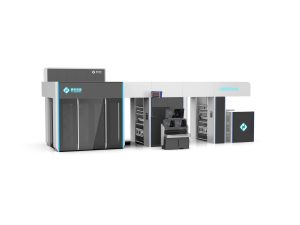
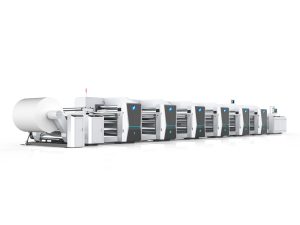
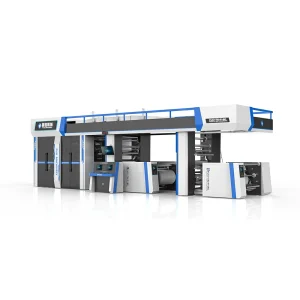
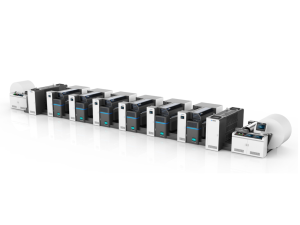
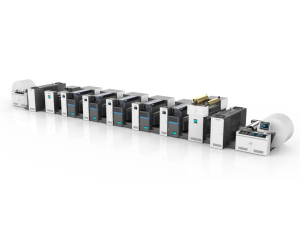
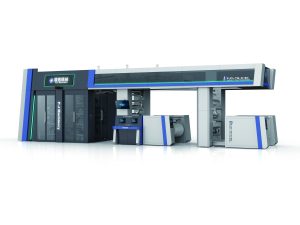
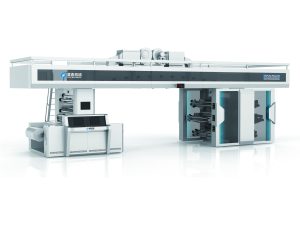
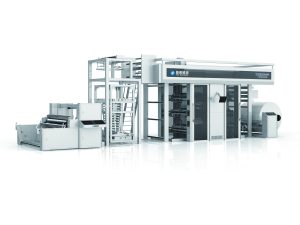
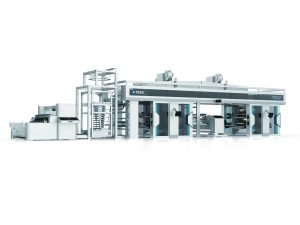
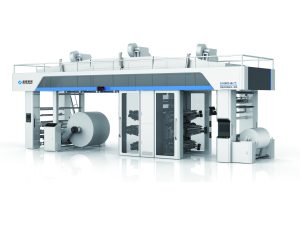
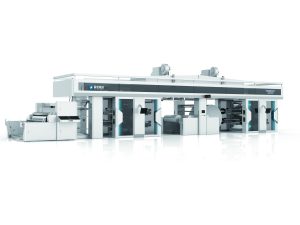
This is why Puji flexo presses come standard with ceramic anilox rollers and enclosed chamber doctor blades across the product line. It’s not a marketing feature — it’s the technical foundation that makes color stability possible. When ink transfer follows math, your printing follows your spec.
For flexo converters, the value is direct: less waste, less ink consumption, and color consistency from the first meter to the last roll.
FAQ: Flexo Ink Transfer and Color Stability
How does an anilox roller control ink volume in flexo printing?
The anilox roller’s cells have a precise volume (BCM). Each revolution transfers exactly what the cells carry, making the anilox roller the metering device of the flexo process.
What is the difference between anilox LPI and plate screen ruling?
Anilox LPI is the cell count on the anilox roller (360–1,400 in narrow/wide web flexo). Plate screen ruling is the halftone density on the plate (85–200 LPI). The anilox must be 3–6 times finer than the plate screen.
Why does my flexo color drift during a run?
Likely causes: incorrect BCM for the job, an open doctor blade where pressure changes affect ink volume, or a worn anilox roller whose BCM has drifted. All three break the “ink math.”
Should I use an enclosed chamber doctor blade?
For consistent color, yes. An enclosed chamber blade locks ink volume to the cell BCM, removing blade pressure as a variable. This is standard on professional flexo presses.
How long does a ceramic anilox roller last?
Ceramic anilox rollers hold their cell geometry far longer than steel, keeping BCM stable over tens of thousands of meters of production. They are the professional standard for consistent flexo color.
Can I change the anilox roller BCM later?
Yes — anilox rollers are interchangeable components. Selecting the right BCM/LPI pair for each job (or family of jobs) is part of flexo process control.
Conclusion: Flexo Color Is Calculated, Not Tuned
Color drift in flexo printing isn’t a mystery, and it isn’t the operator’s fault. It’s the result of an ink transfer chain that has come unlocked — a wrong BCM, an open doctor blade, or a worn roller.
The fix is structural: meter the ink with the right BCM/LPI pair, seal it with an enclosed chamber blade, and keep it honest with a ceramic anilox roller. When the math holds, the color holds.
If you’re evaluating a flexo press or troubleshooting color consistency on your current line, ask about these three locks — they determine whether your color is calculated or just hoped for.
About Zhejiang Puji Packaging Machinery Co., Ltd.
Zhejiang Puji Packaging Machinery Co., Ltd. is a technology-driven group enterprise with over 20 years of flexo engineering experience, 50+ invention patents, and 500+ machines installed across 50+ countries. All machines are ISO 9001:2015 and CE certified. Puji flexo presses come standard with ceramic anilox rollers and enclosed chamber doctor blades across the product line.
Tags: flexo printing ink transfer, anilox roller BCM, flexo anilox LPI, flexo color consistency, enclosed doctor blade flexo, ceramic anilox roller, flexo printing machine, flexo color drift, anilox roller selection