Skip to content
Meta Description: Plastic mailers are one of the fastest-growing packaging segments in e-commerce — but printing them well requires the right press. This guide covers mailer materials, printing challenges, and the CI flexo configuration that delivers stable results at 200m/min.
Every day, millions of e-commerce orders ship worldwide in lightweight plastic mailers — the gray poly bags from Amazon, the branded courier bags from Shopify sellers, the recycled-content mailers from eco-conscious brands. They are light, waterproof, and cheap to transport. And nearly every one of them carries printed branding: a logo, a return address, a “FRAGILE” warning, sometimes a full-color design.
For packaging converters, plastic mailer printing represents a fast-growing, high-volume opportunity. But it also presents a specific set of technical challenges — thin, stretchable film, demanding tension control, and registration that must hold across long runs.
The short answer: plastic mailers are best printed on a Central Impression (CI) flexo press, because the central drum keeps thin film tension stable and registration precise. This guide explains why, and what to look for when choosing a machine.
1. How Big Is the Plastic Mailer Market?
Plastic mailers (also called poly mailers, polybags, or courier bags) are one of the fastest-growing segments in flexible packaging. Global market research firms (Fortune Business Insights, Next Move Strategy Consulting, Future Market Insights) consistently report strong growth, driven by:
- E-commerce expansion — online retail continues to grow double digits year over year, and virtually every order needs a shipping bag
- Lightweight economics — plastic mailers cost less to produce and transport than boxes, making them the default choice for non-fragile goods
- Branding demand — as DTC brands compete on unboxing experience, printed mailers have become a marketing surface, not just a shipping necessity
- Sustainability shift — recycled-content and recyclable mailers are growing fast, and these still need printing
The takeaway for converters: mailer printing demand is growing steadily, and the barrier to entry is a machine that can print thin PE film reliably.
2. What Materials Are Plastic Mailers Made Of?
Understanding the substrate is the first step to printing it well. Most plastic mailers are made from:
Material Typical Thickness Characteristics Printing Notes LDPE (Low-Density PE) 30–80 μm Soft, flexible, high stretch Most common; requires careful tension HDPE (High-Density PE) 15–40 μm Stiffer, noisier, “crinkly” feel Lower stretch, easier register MDPE / Blends 25–60 μm Balanced properties Common in recycled-content mailers Recycled PE varies May have inconsistent gauge Requires tolerant tension control Key characteristic: plastic mailer film is thin and stretchable. A 40-micron LDPE film can stretch several percent under tension — enough to shift registration visibly between color stations. This single fact drives most of the printing challenges below.
3. The Three Biggest Challenges in Plastic Mailer Printing
3.1 Film Stretch and Tension Variation
Thin PE film is elastic. As the unwind roll diameter changes during a run, tension drifts. On a press without precise tension control, the film stretches unevenly — and every color station prints on a slightly different material length. The result: registration that drifts over the course of a roll.
3.2 Registration Drift at Speed
At production speeds of 150–200 m/min, a small tension variation becomes a measurable registration error. A stack-type press, where the film travels a long, unsupported path between color stations, is especially vulnerable. Operators compensate by slowing down — which cuts productivity.
3.3 Ink Adhesion and Surface Energy
PE film has low surface energy, meaning ink doesn’t naturally want to stick. Proper corona treatment before printing is essential, along with inks formulated for film substrates. This is a process issue, not a press-structure issue, but it must be part of the production plan.
4. What Machine Should You Use to Print Plastic Mailers?
This is the core question, and the answer comes down to press structure.
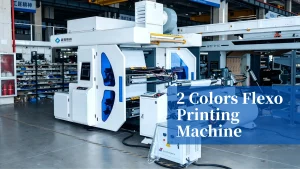
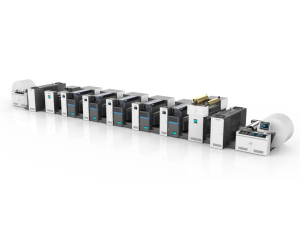
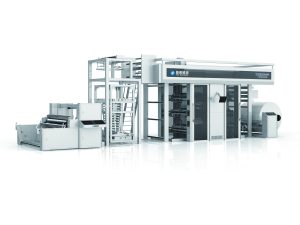
Stack-Type Flexo Press: The Budget Option with Limits
A stack press prints on films, papers, non-wovens, and woven bags. It is the most economical flexo configuration, and many converters start here. However:
- The web travels through several independent printing stations without a central support drum
- On thin, stretchable film, this longer unsupported path amplifies tension variation
- Registration on PE film typically drifts more than on paper or woven materials
Stack presses are excellent value for paper, non-woven, and woven bag printing — but for thin PE mailer film at high speed, they have structural limits.
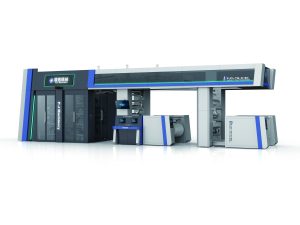
CI (Central Impression) Flexo Press: The Film Specialist
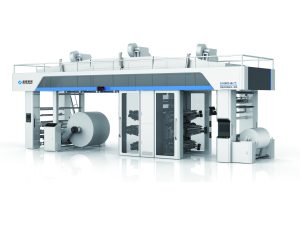
A Central Impression press wraps the film around one large steel drum. All printing stations are arranged around that drum, and the film is continuously supported through every color.
The benefits for mailer printing are direct:
Benefit Why It Matters for Mailers Stable tension Film is held against the drum, minimizing stretch and flutter Precise registration All colors print against the same drum reference — less drift Higher speeds Tension stability allows 200 m/min+ production without quality loss Lower waste Fewer registration rejects across long runs For high-volume plastic mailer printing, a CI flexo press is the structural answer.
5. The Economic CI Press: A Realistic Entry Point
Many converters assume CI presses are out of budget. This is where the market has changed: economic CI flexo presses now bring central-impression stability at a fraction of the cost of full-servo machines.
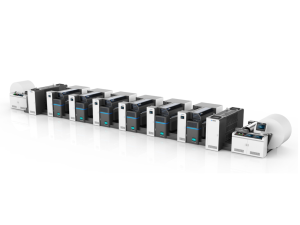
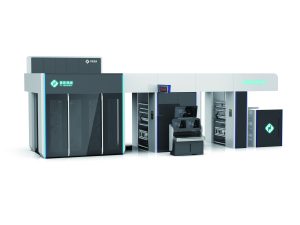
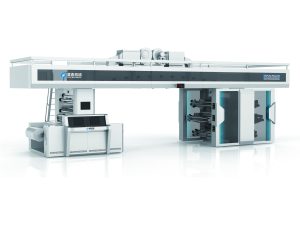
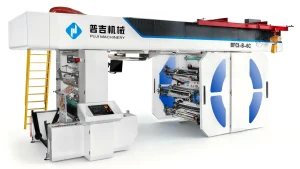
The BFCI-B Series from Puji Machinery is a representative example of this category:
Specification BFCI-B Economic CI Printing colors 4–8 (up to 4+4 double-sided) Max material width 600–2700 mm Printing speed up to 200 m/min Registration accuracy ±0.15 mm Anilox roller Ceramic, shaft type Doctor blade Enclosed chamber Ink system Auto circulation Control PLC + touchscreen Optional Corona treatment, UV drying, no-stop unwind/rewind Key point: the central impression drum — the component that makes film printing stable — is fully present in economic CI presses. What’s scaled back is servo automation and sleeve technology, not the core structure.
6. What to Look for When Buying a Mailer Printing Press
Whether you choose an economic CI or a higher-spec model, check these before you buy:
- Is the central drum temperature-controlled? For thin film, a stable drum surface (within ±1°C) reduces heat-related distortion
- What tension control is included? Look for closed-loop tension between unwind, print, and rewind zones
- Is corona treatment available? Essential for ink adhesion on PE — confirm it’s offered as standard or option
- What is the real registration accuracy? Ask for the long-run number, not just the fresh-machine spec
- Can you trial it on actual mailer film? A real-material test at production speed reveals more than any spec sheet
- What drying system is fitted? Water-based inks need adequate drying at 200 m/min to prevent smearing and blocking
7. Production Considerations for Consistent Mailer Printing
Beyond the machine, these process factors determine day-to-day quality:
- Corona treatment discipline — treat the film before printing and verify surface energy (dyn level) regularly
- Ink selection — use inks formulated for PE film; consider water-based for food-adjacent applications
- Tension recipes — store tension profiles by material (LDPE vs HDPE vs recycled) for repeatable setups
- Roll quality — consistent gauge and good winding from the film supplier reduces tension surprises
- Operator training — even the best CI press depends on skilled setup and maintenance
FAQ: Plastic Mailer Printing
What machine is best for printing plastic mailers?
A Central Impression (CI) flexo press is best for thin PE mailer film, because the central drum keeps tension stable and registration precise at high speed.
Can a stack flexo press print plastic mailers?
Yes, stack presses can print mailers, especially at moderate speeds. However, on thin stretchable film, stack presses are more prone to tension variation and registration drift than CI presses.
What is the typical printing speed for mailers?
On a CI flexo press, mailers can be printed at 150–200 m/min with stable quality. Economic CI models like the BFCI-B reach up to 200 m/min.
What materials are plastic mailers made of?
Most are LDPE, HDPE, or blends, typically 15–80 microns thick. Recycled-content PE mailers are also common and growing.
Do I need corona treatment to print on PE mailers?
Yes. PE film has low surface energy, so corona treatment before printing is essential for ink adhesion.
Is an economic CI press enough for mailer printing?
Yes, if your core requirement is stable film printing at high volume. Economic CI presses keep the central drum structure — the key to film stability — while scaling back servo automation and sleeve technology.
Conclusion: Match the Press to the Material
Plastic mailer printing is a growing, high-volume opportunity — but it rewards the right machine choice. Thin, stretchable PE film demands the tension stability and precise registration that a Central Impression press provides. And with economic CI presses now available, this capability is within reach of far more converters than before.
Match the machine to the material, and mailer printing becomes a stable, profitable production line.
If you’re evaluating a flexo press for mailer or film printing, send us your substrate details and target speed — we’ll help you configure the right machine.
About Zhejiang Puji Packaging Machinery Co., Ltd.
Zhejiang Puji Packaging Machinery Co., Ltd. is a technology-driven group enterprise with over 20 years of flexo engineering experience, 50+ invention patents, and 500+ machines installed across 50+ countries. All machines are ISO 9001:2015 and CE certified. Products include CI flexo presses, stack flexo presses, gravure presses, laminating machines, and slitting rewinders.
Tags: plastic mailer printing, poly mailer printing machine, courier bag printing, CI flexo press for film, economic CI flexo press, BFCI-B, e-commerce packaging printing, PE film flexo printing, flexible packaging machine


Meta Description: Belt drive or gear drive for your stack