Skip to content
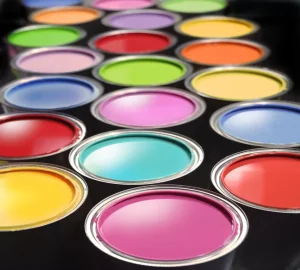
Ink is one of the largest variable costs in film printing — and it’s where flexo and gravure part ways most sharply. In real production, flexographic printing can consume up to three times less ink than gravure on the same film. This isn’t marketing — it comes down to physics.
Key Takeaways
- Flexo consumes up to 3× less ink than gravure on plastic film — around half on other substrates.
- The reason is ink film thickness: flexo lays down 1–5 μm, gravure 5–20 μm.
- Flexo meters ink with an anilox roller (BCM); gravure fills engraved cells that transfer directly.
- Solvent and drying energy drop too — flexo’s closed chamber cuts solvent loss by a wide margin.
- The exact gap depends on substrate, coverage, and color requirements.
The short answer
Flexo uses less ink because it lays down a thinner ink film. Gravure’s engraved cells carry more ink; flexo’s anilox roller meters it precisely. Thinner film means less ink per square meter — it’s that simple.
1. Ink film thickness — the root cause
Ink consumption scales directly with film thickness. The two processes operate in different ranges:
That single difference creates a 2–4× gap before a drop of ink is even wasted. Gravure is engineered to lay down a heavy, saturated film; flexo is engineered for a controlled, thin one.
The same relationship holds across major printing processes — film thickness is the primary driver of ink usage.
2. Metered transfer vs. filled cells — the mechanism
Gravure: The cylinder floods with ink; a doctor blade scrapes the surface clean; ink inside each engraved cell transfers directly to the film. The deeper the cell, the heavier the film — and deep cells are standard practice for rich, saturated color. More saturation, more ink.
Flexo: Ink moves from a closed chamber onto an anilox roller, whose engraved volume — measured in BCM (billion cubic microns per square inch) — determines exactly how much ink is carried. That metered ink transfers to the flexible plate, then to the substrate.
The quality of that anilox roller is critical. Industry anilox standards (Harper Corporation technical data) specify:
- Surface hardness: 1100–1300 Vickers (above this, the ceramic becomes brittle)
- Porosity: ≤ 1%
- Surface roughness (Ra): ≤ 3.0 before laser engraving
- Cell geometry: 60° hexagon — the industry standard for consistent transfer
An anilox that holds its BCM value over millions of impressions delivers consistent color — and consistently lean ink usage.
3. It’s not only ink — solvent drops too
Gravure typically runs an open ink pan, where solvent evaporates freely. Flexo uses a closed chamber with circulation, dramatically reducing evaporation.
Measured production data (per 10,000 m²):
Solvent is a second cost that falls alongside ink — and a compliance cost, too (VOCs).
4. Why temperature and ink stability matter
Ink viscosity is the hidden variable. Industry testing (INX International) shows temperature is the single biggest factor in viscosity — a small change shifts ink thickness, color density, and drying. That’s why closed-loop temperature control on the ink system isn’t a luxury: it keeps a thin flexo film consistent.
A 2025 open-access study from Lviv Polytechnic National University (Ukraine) confirmed the same on wide CI flexo presses: ink temperature control significantly affects transfer stability and efficiency. Anilox geometry and cell angle also influence transfer.
5. The real numbers — and why it’s “2–3×”, not a fixed figure
The actual gap depends on three variables: substrate, coverage, and color requirements.
For disposable film that doesn’t require highly saturated color, flexo can run a low-BCM anilox — minimal ink, maximum efficiency. For richer color work, the gap narrows toward half.
6. Why this matters now — the market context
This isn’t a niche debate. Flexo is the dominant packaging process globally:
- Flexo accounts for ~40% of global packaging printing and nearly 60% of flexible packaging output (Smithers, The Future of Flexographic Printing to 2029).
- The global flexo printing market is projected to grow from 230.5B(2024)to262.7B (2029), a 3.0% CAGR (Smithers).
- Adoption varies sharply by region: North America ~80%, Europe ~50%, but Asia only ~20% (Smithers) — huge headroom where gravure still dominates.
- 72% of consumers say packaging influences purchase decisions (Paper and Packaging Board).
- 88% of flexo/converting plants rank “maximizing efficiency” as their top priority (FTA, 2026).
Flexo’s speed ceiling is around 600 m/min vs. gravure’s ~1000 m/min (Converting Quarterly, 2025) — but for film work, flexo’s thin ink film, lower waste, and short web path often win the total cost equation.
7. What it means for a printing business
Three costs drop at once: ink, solvent, drying energy. On high-volume, thin-margin disposable film, that’s the difference between a profitable job and a break-even one.
Academic work reinforces the upside of doing it right: MIT research (Science Advances) shows flexographic pressure has an optimal window (28–150 kPa), and that flexo’s physical speed limits are far from reached. A TAGA study (Swansea University, 1998) on commercial CI presses found impression pressure mainly affects tonal gradation, while chamber pressure drives solid density — machine setup, not just chemistry, decides ink efficiency.
When flexo wins on film
- Disposable / single-use film — dust covers, tablecovers, aprons, shoe-cover fabric
- Jobs that don’t need extreme color saturation
- High-volume runs, where ink savings compound over millions of meters
FAQ
Q1: Is flexo always cheaper than gravure? Not always — gravure can win on very long runs with high color demands and low cylinder costs. But on ink consumption alone, flexo is consistently lower.
Q2: Does less ink mean lower print quality? No. A thinner flexo film means less dot gain and sharper detail; modern CI flexo presses reach ±0.05 mm registration.
Q3: How much could I save? On disposable film, ink savings can reach two thirds; on other substrates, around half — depending on coverage and color.
Q4: Can flexo run the same thin, stretchy films? Yes — especially CI flexo presses, whose short web path and closed-loop tension control handle thin film exceptionally well.
Q5: Does using less ink also cut emissions? Yes. Lower ink and solvent use means lower VOC emissions and drying energy — a compliance and sustainability benefit alongside cost.
Conclusion
Flexo and gravure each have their place. But when it comes to ink efficiency on plastic film, flexo has a structural advantage — a thinner film, metered transfer, and a closed ink system. On disposable film, that can mean two-thirds less ink. And in thin-margin packaging, efficiency is the whole game.
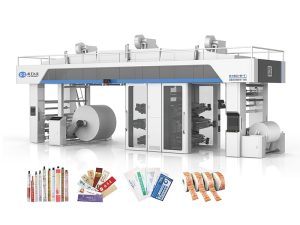
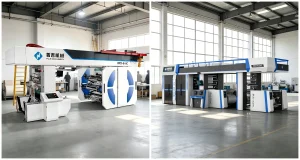
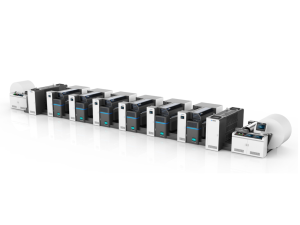
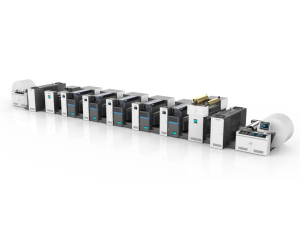
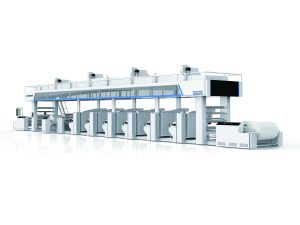
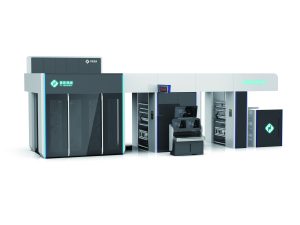
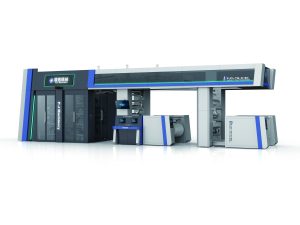
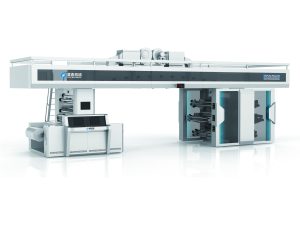
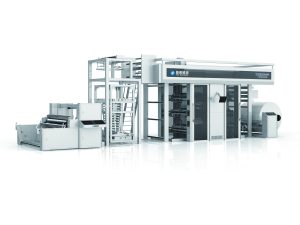
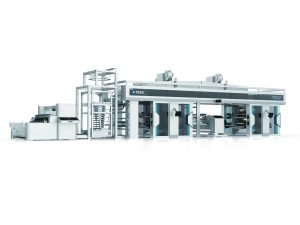
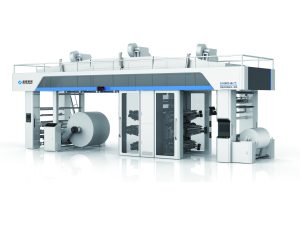
Printing plastic film? See what flexo could save you. 👉 Explore our [CI flexo printing machines] and [stack flexo printing machines] — or [talk to our engineers] for a cost comparison on your job.


In order to scrape the excess ink from the surface