Skip to content
Meta Description: Tablecovers and dust covers are printed HDPE film — and they need double-sided printing and wide width. Here’s how a stack flexo press handles both in one pass, and why it matters for your profit.
Think about the last party you attended. The tablecover — printed with flowers, stripes, or a holiday theme. Or the dust cover protecting a sofa during a home renovation. Chances are, both are printed HDPE film.
These products look simple, but the market behind them is anything but small. Party tablecovers, furniture dust covers, garment bags, disposable aprons — the hospitality and event industries use them by the millions, all year round.
And here’s what most converters discover only after buying the wrong machine: these products have two hard requirements that decide which flexo press you need.
- Many need printing on both sides — tablecovers with patterns on both faces, dust covers with branding or instructions inside and out.
- Many are large — full-size tablecovers and sofa dust covers need wide web width to print in one piece.
This guide explains how double-sided, wide-width flexo printing works for HDPE disposable products — and why a stack-type press is the natural fit.

1. The HDPE Disposable Products Market: Why It’s Worth Your Attention
HDPE film products are a stable, high-volume market for converters:
| Product | Where It’s Used | Why It Needs Printing |
|---|---|---|
| Party tablecovers | Events, restaurants, outdoor dining | Decorative patterns, brand themes |
| Furniture dust covers | Moving, renovation, storage | Size labels, branding |
| Garment bags | Dry cleaning, wardrobes | Branding, size marks |
| Disposable aprons | Food service, hospitality | Brand logos, patterns |
These are consumable products — used once and replaced. That means steady, repeatable demand for the converters who supply them. And because they’re high-volume, low-margin items, production efficiency decides profitability.
2. Three Technical Challenges of Printing HDPE Film
Before choosing a press, understand what HDPE film does during printing:
Challenge 1: HDPE Stretches Easily
HDPE film is thin and stretchy. At high speed, tension control is everything — uneven tension means wrinkles, misregistration, and wasted material.
Challenge 2: The Surface Is Slippery and Low-Energy
HDPE has low surface energy, which makes ink adhesion difficult. Surface treatment (like corona) and properly matched inks are required for durable prints.
Challenge 3: Static Electricity Builds Up
Plastic film generates static at high speed, which attracts dust and can cause print defects. Static elimination is not optional on HDPE runs.
Any press that claims to be “made for HDPE” must handle all three — stability, adhesion, and static control — not just print fast.
3. Double-Sided Printing: One Pass, Both Sides
Here’s the requirement that quietly eliminates many presses: a lot of HDPE disposable products need printing on both sides.
- Tablecovers often carry patterns on both faces.
- Dust covers and garment bags need branding or instructions that read from either side.
How Different Press Types Handle Double-Sided Jobs
| Press Type | Double-Sided Printing | The Cost |
|---|---|---|
| CI (Central Impression) press | Not possible in one pass — all print units sit around one central drum, so only one side prints | Must rewind and print the second side as a separate run: two passes, double handling, double waste |
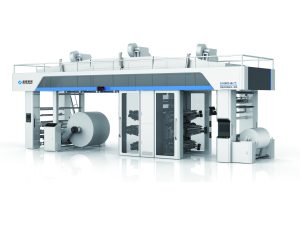
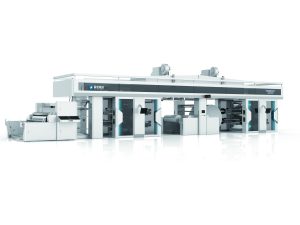
| Stack (stack-type) press | Prints both sides simultaneously — print units are arranged on both sides of the web path | One pass, done |
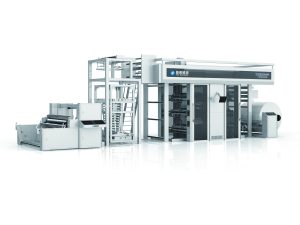
This is a structural difference, not a tuning difference. A CI press physically cannot print both sides in one pass. A stack press can — because its print units are arranged in two vertical stacks, one on each side of the film.
The business impact: double-sided printing in one pass means roughly double the throughput on two-sided jobs, and half the labor. On high-volume, low-margin disposable products, that difference is your profit.
(Note: for single-sided, high-end film printing where registration precision is the top priority, a CI press remains the industry standard. But when double-sided is the requirement — and it often is in disposable products — a stack press is the structurally correct choice.)

4. Wide Width 1600mm+: The Gate to Big Orders
The second hard requirement is size. Full-size tablecovers and sofa dust covers don’t fit on a narrow press.
Why Width Matters
| Narrow Press | Wide Press (1600mm+) |
|---|---|
| Can’t print large products in one piece | Prints full-size tablecovers and dust covers in one pass |
| Forces splicing — extra labor, material waste, visible seams | No splicing — clean, continuous print |
| Loses big orders to wider competitors | Qualifies for large-volume contracts |
If your press tops out at a narrower width, you simply cannot take certain orders — no matter how good your print quality is. Width is a market-access question, not just a spec.
A stack flexo press with custom width above 1600mm lets converters handle large HDPE disposables in one piece: fewer joins, less waste, more orders.
5. Putting It Together: The Right Configuration for HDPE Disposables
The ideal HDPE disposable-products line combines all the pieces:
| Requirement | Solution |
|---|---|
| HDPE stretches easily | Precision tension control across the web path |
| Low surface energy | Corona treatment + matched ink system |
| Static at high speed | Static elimination equipment |
| Both sides need printing | Stack-type press with double-sided units |
| Large tablecovers & dust covers | Custom width above 1600mm |
| High volume, low margin | One-pass double-sided printing for efficiency |
A stack flexo press with these configurations turns HDPE disposable printing into a cost-efficient production line — not a compromise.
FAQ
What flexo press is best for printing HDPE film?
For disposable products like tablecovers and dust covers, a stack-type flexo press is the practical choice — especially when double-sided printing or wide width is needed. CI presses remain the standard for single-sided, high-precision film work.
Why can’t a CI press print both sides in one pass?
A CI press arranges all its print units around one central impression drum, so it can only print the side of the film facing the drum. Printing the reverse side requires rewinding and a second run. A stack press arranges units on both sides of the web, so both sides print in one pass.
How does double-sided printing save money?
Printing both sides in one pass eliminates the second run: roughly double the throughput on two-sided jobs, half the labor, and less material handling and waste.
What width do I need for large tablecovers and dust covers?
Full-size tablecovers and sofa dust covers typically need web widths above 1600mm to print in one piece. Custom-width stack flexo presses are available for this range.
Is stack flexo precision good enough for quality printing?
Modern stack flexo presses with servo drives achieve registration precision close to CI-level performance — more than adequate for disposable product printing, where pattern clarity and consistency matter most.
Can I print HDPE film with water-based ink?
Yes, with proper surface treatment (corona) and ink matched to HDPE’s low surface energy. Ink adhesion and durability depend on the full system: treatment, ink, and drying.
Conclusion: The Profit Formula for HDPE Disposables
HDPE disposable products — tablecovers, dust covers, garment bags, aprons — are a high-volume, low-margin market. Profit comes from efficiency.
Two capabilities decide whether you can serve this market profitably:
- Double-sided printing in one pass — a structural advantage of stack-type presses that CI presses can’t match.
- Wide width above 1600mm — the gate to large-product orders that narrower presses lose.
Get both right, and HDPE disposables become a stable, repeatable revenue line. Get them wrong, and you’ll watch competitors take the orders you couldn’t fit.
If you’re evaluating a press for HDPE disposable products, ask about these two specifications first — they determine what you can print, and what you can earn.
About Zhejiang Puji Packaging Machinery Co., Ltd.
Zhejiang Puji Packaging Machinery Co., Ltd. is a technology-driven group enterprise with over 20 years of flexo engineering experience, 50+ invention patents, and 500+ machines installed across 50+ countries. All machines are ISO 9001:2015 and CE certified.
Tags: HDPE film printing, double-sided flexo printing, wide format flexo press, tablecover printing, dust cover printing, stack flexo press, disposable products printing, flexo printing machine