Skip to content
Ribeye steaks. Whole chickens. Salmon fillets. Shrimp. Look at any supermarket’s fresh-food case, and you’ll see them — each one sealed in a printed shrink bag. It’s a market that never stops moving, and every bag needs to be printed.
This article explains why fresh-food shrink bags are printed on CI flexo presses, and what to look for in the machine.
Key Takeaways
- Shrink bags are made from thin, stretchy food-grade film (POF/PE) — demanding to print well.
- CI (central impression) flexo presses keep registration tight thanks to a short web path and closed-loop tension control.
- Registration accuracy reaches ±0.05 mm even on thin film at high speed.
- Applications: meat, poultry, seafood, and ready-to-cook fresh food packaging.
- Demand is steady and year-round — fresh food is bought every day.
1. What are fresh-food shrink bags?
Shrink bags are used to package fresh food under vacuum or modified atmosphere. Once heated, the film shrinks tight around the product and seals it in, keeping it fresh and extending shelf life.
They’re typically made from:
- POF (multi-layer co-extruded polyolefin) — the most common choice: clear, tough, high shrink rate
- PE (polyethylene) — used in certain heavier-duty applications
Both are thin, transparent, and highly elastic. That combination is exactly what makes them valuable in packaging — and hard to print.
2. Why shrink film is hard to print
Three characteristics define the challenge:
- Thin — films run as thin as 12 μm in some applications
- Stretchy — film deforms under tension, which shifts registration
- Heat-sensitive — the print must survive the shrinking and sealing process
Between print stations, a stretching film changes dimension — and registration drifts. The longer the web path, the more chances the film has to deform.
3. Why CI (Central Impression) is the right architecture
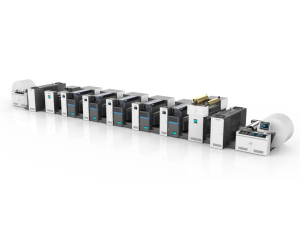
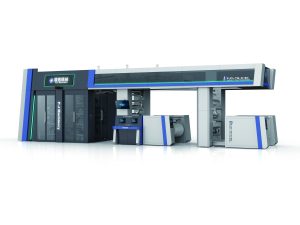
In a CI flexo press, the film travels around one large central drum, with all color stations arranged around it. This design solves the shrink-film problem in three ways:
For thin, stretchy film, that combination is decisive. It’s why CI is the go-to architecture for flexible packaging — and the reason a stack press, with its long web path, struggles with the same jobs.
4. What to look for in a CI flexo press
Key specifications for fresh-food shrink bag printing:
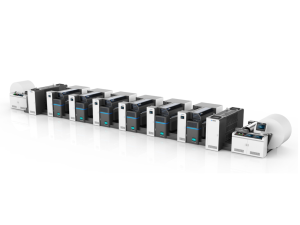
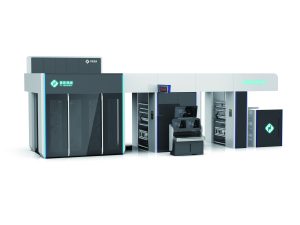
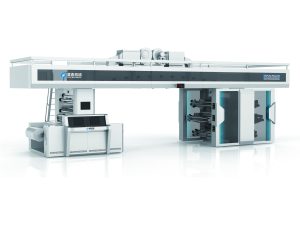
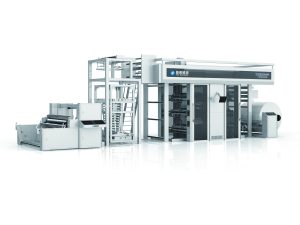
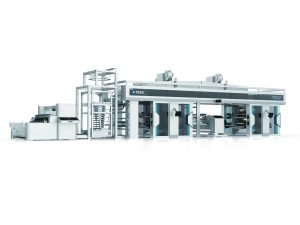
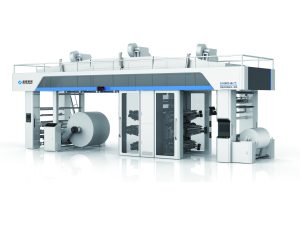
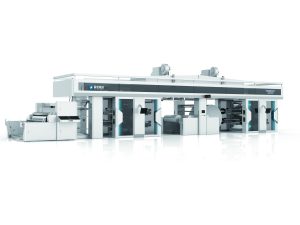
Puji’s BFCI-B series is a full-servo, sleeve-type CI flexo press built for exactly this — food-grade shrink film, high-speed registration, and stable tension on thin, elastic substrates.
5. Market context
Fresh-food packaging is a large and growing market — and shrink-bag printing sits right inside it:
- The CI flexo press market is projected to grow from 2.645B(2025)to3.685B (2032), a 4.85% CAGR, with flexible packaging at 70.26% of applications (PW Consulting).
- Globally, flexo accounts for nearly 60% of flexible packaging output (Smithers).
- Puji Machinery is listed among the key global CI flexo press manufacturers in PW Consulting’s Worldwide Central Impression Flexo Press Market 2026 report — alongside W&H, Bobst, Comexi, Uteco, and SOMA.
Demand is steady: fresh food is bought every day, in every market — and so are its packaging films.
6. Applications
A CI flexo press for shrink bags covers a broad range:
- Meat & poultry — beef, pork, chicken
- Seafood — fish fillets, shrimp, shellfish
- Ready-to-cook — marinated and prepared fresh products
- Any product needing a tight, sealed, printed shrink pack
FAQ
Q1: Can a stack flexo press print shrink bags? It can run film, but a long web path makes it harder to hold registration on thin, stretchy film. A CI press with a short web path is the better fit.
Q2: What film materials can CI flexo print? Food-grade POF and PE shrink films, plus many other flexible substrates.
Q3: What registration accuracy is achievable? Modern full-servo CI presses reach ±0.05 mm — critical for brand and regulatory print on small packs.
Q4: Will the print survive shrinking and sealing? Yes — with the right ink and film combination. The press’s temperature-controlled ink system helps keep quality consistent.
Q5: Why choose a CI press over gravure for shrink bags? For film work, CI flexo offers lower ink and solvent consumption, a short web path, and high speed — often a lower total cost per print.
Conclusion
Fresh-food shrink bags are a steady, high-volume market — and printing them well starts with the right press architecture. A CI flexo press keeps thin film stable, registration tight, and costs lean.
Printing shrink bags for fresh food? 👉 Explore our [CI flexo printing machines] — or [talk to our engineers] about the right configuration for your film.


As the packaging industry shifts toward sustainability, printing on biodegradable