Skip to content
When selecting industrial machinery for packaging or converting lines, floor space is often as valuable as the equipment itself. CI (Central Impression), Stack, and Unit Type layouts represent three distinct approaches to machine configuration, each offering different space efficiencies, accessibility, and scalability. Understanding these machine layout types helps you optimize your production floor without compromising performance. At PuJi Machinery, we engineer all three configurations to match your space and production goals. Explore our solutions at Our Web.
Space-Saving Layouts: Key Characteristics
The table below compares the three primary machine layouts across critical factors. Use this to identify which configuration best suits your facility and production needs.
| Feature | CI (Central Impression) | Stack Type | Unit Type (Modular) |
|---|---|---|---|
| Configuration | Single central drum with multiple color stations around it | Vertically stacked decks (2–6 colors) | Horizontally arranged independent units |
| Footprint | Most compact; narrowest width | Medium; width similar to CI but requires height clearance | Largest; requires longest linear space |
| Accessibility | Good for operational control; limited between stations | Good for top decks; bottom decks may be cramped | Excellent; individual units accessible from all sides |
| Web Path | Shortest web path; minimal tension variation | Moderate web path length | Longest web path; more tension control points |
| Scalability | Fixed number of stations (typically 4–8) | Fixed number of decks | Highly scalable; add units as needed |
| Typical Applications | High-quality flexible packaging, thin films | Simple packaging, paper, less demanding print | Multi-process lines (printing, coating, laminating) |
CI (Central Impression) Layout – The Compact Powerhouse
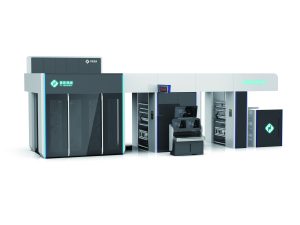
The Central Impression (CI) layout revolves around a single, large-diameter drum or cylinder. All processing stations—typically printing decks, coating units, or laminating stations—are arranged radially around this central drum. The substrate (web) is held firmly against the drum surface as it moves from station to station, maintaining precise registration and minimal web movement.
Space advantages: The CI configuration offers the most compact footprint of all three layouts. Because stations are positioned around a central point rather than in a line or stacked vertically, the machine occupies significantly less floor space per station. For facilities with limited floor area but requiring multiple processing steps, CI layouts can reduce required length by 40–60% compared to unit-type configurations.
Operational characteristics: The short web path minimizes tension variations and substrate distortion, making CI ideal for thin films, elastic materials, and high-quality printing. The central drum maintains consistent temperature control, which is critical for solvent-based and water-based processes. However, the number of stations is fixed at the time of manufacture—typically 4 to 10 stations—making expansion difficult without replacing the entire machine.
Best applications: High-speed flexible packaging printing, laminating, and coating where print quality and registration accuracy are paramount.
Stack Type Layout – Vertical Space Optimization
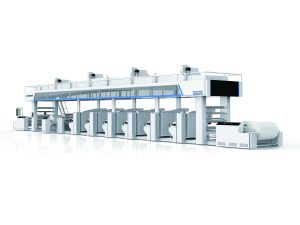
The Stack Type layout arranges processing decks vertically, one above another. Each deck houses a separate processing unit—a printing station, coating head, or drying section—stacked in a tower-like configuration. The web travels upward or downward through the stack, passing through each station sequentially.
Space advantages: Stack configurations save floor space by building vertically rather than horizontally. While the footprint (width and length) is similar to a CI machine, the stack requires greater ceiling height—typically 4–6 meters depending on the number of decks. For facilities with high ceilings but limited floor area, stack layouts provide an excellent space-saving alternative to unit-type machines. They occupy approximately 30–50% less floor length than modular unit configurations.
Operational characteristics: Each deck is independently accessible for setup and maintenance, though upper decks may require platforms or lifts. The web path is longer than CI but shorter than unit type. Stack designs are generally simpler mechanically, resulting in lower initial cost per station compared to CI machines. However, tension control becomes more complex as the number of decks increases, and access to lower decks can be restricted.
Best applications: Simple to medium-complexity printing on paper, films, and non-wovens; cost-sensitive applications where floor space is limited but vertical clearance is available.
Unit Type (Modular) Layout – Maximum Flexibility
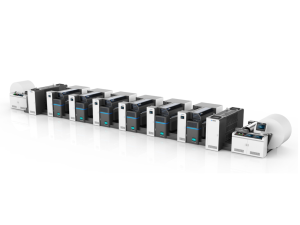
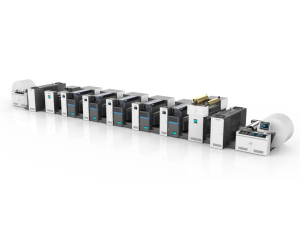
The Unit Type layout, also known as modular or in-line configuration, arranges processing stations horizontally in a linear sequence. Each unit—printing station, coating unit, laminator, slitter, etc.—is a self-contained module connected by web transport sections. Units can be added, removed, or rearranged as production requirements change.
Space advantages: Unit type layouts require the largest floor area of the three configurations. A 6-color unit-type press may span 15–25 meters in length. However, this linear arrangement allows for strategic placement of units in L-shapes or with bypass sections to work around existing facility constraints. The space disadvantage is offset by superior scalability—you can start with 2 units and expand to 8 or more over time, spreading capital investment.
Operational characteristics: Each unit offers excellent accessibility from all sides, simplifying setup, maintenance, and cleaning. The modular nature allows mixing different technologies (e.g., flexo and gravure in one line, or printing and laminating in sequence). The longer web path introduces more tension control points, requiring sophisticated automated tension systems for consistent quality. Unit type machines are the most versatile for multi-process lines.
Best applications: Complex production lines combining multiple processes (printing, coating, laminating, slitting); operations requiring frequent configuration changes; businesses planning phased expansion.
Choosing the Right Layout for Your Facility
Select CI layout when:
-
Floor space is severely limited
-
Print quality and registration accuracy are critical
-
You process thin, stretch-sensitive films
-
The number of stations is fixed and known
-
You have adequate budget for higher upfront investment
Select Stack layout when:
-
Floor space is limited but ceiling height is available
-
Budget is a primary consideration
-
You process less demanding substrates (paper, board, simple films)
-
You need 2–6 stations and moderate accessibility
Select Unit Type layout when:
-
You have ample floor space
-
Future expansion or reconfiguration is planned
-
You combine multiple processes (print + laminate + slit)
-
Accessibility and ease of maintenance are top priorities
-
You value the ability to start small and scale over time
Beyond Space: Other Considerations
While space is a primary driver, consider these additional factors:
-
Capital investment: CI machines typically have the highest initial cost due to precision engineering. Stack offers lower entry cost. Unit type allows phased investment.
-
Changeover time: CI machines often offer faster changeovers due to automated systems. Stack may require more manual adjustment, especially on lower decks. Unit type can have longer changeovers due to longer web path but offers easy access.
-
Operator safety: Stack layouts may require working at heights, adding safety considerations. CI and unit type keep operators at ground level.
-
Ventilation and utilities: Stack configurations may have higher utility demands for drying units located at different heights, requiring more complex ducting.
FAQs
1. Which layout saves the most floor space?
CI (Central Impression) offers the smallest footprint per processing station, reducing floor length by 40–60% compared to unit type configurations.
2. Can I expand a CI machine to add more stations later?
No. CI machines have a fixed number of stations determined by the central drum size. Expansion requires replacing the entire drum assembly, which is rarely cost-effective.
3. What ceiling height do I need for a stack-type machine?
For a 6-deck stack, plan for 5–7 meters of clear ceiling height, including space for platforms, lighting, and ventilation ducting.
4. Is unit type more expensive than stack type?
For the same number of stations, unit type often has higher total cost due to longer web path, additional tension control systems, and more structural components. However, it allows phased investment.
5. Which layout is easiest to maintain?
Unit type provides the best accessibility—each unit is fully accessible from all sides. Stack layouts may require platforms or lifts for upper decks. CI offers good operational access but limited room between stations for major maintenance.
6. Can I combine different technologies in a CI machine?
Yes. CI platforms can integrate printing, coating, and laminating stations around the central drum, but all stations must fit within the drum’s circumference.
7. What is the typical lead time for each layout?
CI and stack machines typically have lead times of 3–6 months depending on complexity. Unit type modular systems can have shorter lead times for base units, with longer lead times for specialized modules.
Conclusion
CI layouts offer the most compact footprint with superior quality for film processing. Stack layouts maximize vertical space at lower cost, ideal for simpler applications. Unit type layouts provide maximum flexibility and scalability at the cost of larger floor area. Match your facility’s space profile, production requirements, and growth plans to the right configuration.
Need help optimizing your production floor? PuJi Machinery engineers custom converting lines in CI, stack, and unit type configurations. Contact our team today for a free space-planning consultation!