Skip to content
As the packaging industry shifts toward sustainability, printing on biodegradable plastics (like PLA, PBAT, or PHA) has become a critical capability for converters. However, these eco-friendly materials behave very differently from conventional polyolefins (like PE or PP). Their unique surface properties, heat sensitivity, and variable quality present specific challenges. Successfully printing on them requires a deep understanding of the material and a flexo press equipped with the right features to handle their delicate nature.
Biodegradable vs. Conventional Plastic Films: Key Printing Differences
The table below outlines the fundamental differences between printing on standard fossil-based plastics and biodegradable alternatives.
| Property | Conventional Plastic Films (PE, PP, PET) | Biodegradable Plastic Films (PLA, PBAT, Blends) | Printing Challenge/Requirement |
|---|---|---|---|
| Surface Tension (Dynes) | Often treated at manufacture to 38-42 dynes/cm, relatively stable. | Can be lower or unstable; surface energy decays faster after treatment. | Requires in-line corona treatment just before printing to ensure consistent ink wet-out and adhesion. |
| Heat Resistance | Generally higher melting points (e.g., PE ~115°C+, PET ~250°C). | Lower softening points (e.g., PLA ~60°C). Prone to stretching or deformation. | Precise, low-temperature drying and minimal web tension to avoid heat distortion. |
| Dimensional Stability | Relatively stable under tension. | Can be “stretchy” or dimensionally sensitive to tension and heat. | Requires ultra-precise, servo-driven tension control across all zones to maintain registration. |
| Ink Adhesion | Well-understood chemistry; many standard inks available. | Chemically different; requires specially formulated “compostable” or high-adhesion inks. | Need for specialized ink systems and thorough curing/drying to ensure adhesion without migration. |
| Material Consistency | Highly consistent, mature manufacturing processes. | Can vary between batches or suppliers; blends are common. | Press must be easily adjustable to accommodate material variations without extensive re-qualification. |
The Surface Energy Challenge: Ensuring Ink Adhesion
The most common challenge when printing on bioplastics like PLA is achieving consistent ink adhesion. These materials often have a naturally lower surface energy than treated polyolefins, and any corona treatment applied by the film manufacturer can decay significantly before the film reaches your press. To guarantee proper ink wet-out and adhesion, a modern flexo press must be equipped with an in-line corona treater positioned immediately before the first printing station. This treats the web “just in time,” raising its surface energy to the optimal 40-42 dynes/cm and ensuring the first ink layer bonds effectively. Without this, you risk ink “fisheyeing,” poor adhesion, and failed adhesion tests.
Heat Sensitivity: Mastering Low-Temperature Drying
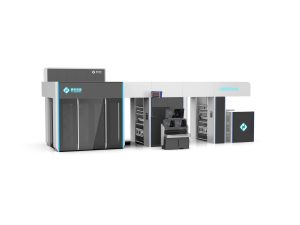
Biodegradable films are notoriously heat-sensitive. PLA, for instance, can begin to soften and distort around 60°C, far lower than traditional films. This makes the drying system a critical machine requirement. Powerful but precisely controllable low-temperature drying is essential. Presses must be equipped with dryers that can deliver high air volume for effective ink drying but with carefully regulated heat that won’t deform the web. This often involves using longer dryer tunnels (a key advantage of unit-type presses) to allow adequate drying time at lower, safer temperatures. Infrared heaters can also be problematic due to localized hot spots, making advanced hot-air systems the preferred choice.
Tension Control: Managing an Unstable Web
Many biodegradable films are more extensible or “stretchy” than their conventional counterparts. They can easily elongate under tension, leading to registration issues and inconsistent print length. To handle this, the flexo press must feature a highly sophisticated, closed-loop tension control system. This means independent servo drives on each unwind, infeed, print station, and rewind, all working in concert to maintain micro-tensions precisely. The press should allow operators to set and hold extremely low tensions throughout the job, from the unwinding roll through every printing unit to the final rewind, compensating for any tendency of the material to stretch.
Ink and Curing Compatibility
Standard flexo inks are not always suitable for biodegradable substrates. They may not adhere properly, or they could compromise the material’s compostability. Printing on these films often requires specially formulated inks, such as water-based inks designed for low-energy surfaces or specific UV/EB inks that cure without excessive heat. The printing press must be compatible with these chemistries. This includes using anilox rolls and chambered doctor blade systems that are chemically resistant and can handle the specific rheology of the inks. Furthermore, if using UV systems, they must be powerful enough to fully cure the ink without overheating the sensitive substrate.
Press Adjustability for Variable Materials
The biodegradable plastics market is still evolving, with frequent blend variations and differences between suppliers. A press that is rigid and difficult to adjust will struggle with this variability. Therefore, converters need a machine designed for maximum operational flexibility. This means quick-change features for anilox rolls and plate cylinders to rapidly adjust ink volumes or print repeat lengths. It also means easily accessible and repeatable settings for impression pressures and dryer temperatures. A press that allows operators to make fine, repeatable adjustments quickly becomes a powerful tool for adapting to different batches of material without excessive waste or downtime.
FAQs
Q: What is the most common problem when printing on PLA film?
A: The most common issue is poor ink adhesion due to low surface energy. This is typically solved by using an in-line corona treater immediately before the first print station to raise the film’s dyne level consistently.
Q: Can I use my existing flexo press to print on biodegradable films?
A: Possibly, but success depends on its capabilities. You will likely need in-line corona treatment, exceptionally precise low-tension control, and dryers that can effectively cure inks at lower temperatures to avoid distorting the heat-sensitive film.
Q: Do I need special inks for printing on compostable plastics?
A: Yes, it is highly recommended. Standard inks may not adhere well or could render the final package non-compostable. You should use inks specifically formulated for biodegradable substrates, often water-based or specially designed UV/EB systems.
Q: Why is tension control more critical for bioplastics than for traditional PE?
A: Many biodegradable films are more sensitive to stretching under tension. If the press tension is too high or not perfectly controlled, the web can elongate, causing misregistration (colors out of alignment) and inconsistent print repeat lengths.
Conclusion
Printing on biodegradable plastics is technically demanding but commercially essential. Success hinges on understanding the material’s unique properties—low surface energy, heat sensitivity, and dimensional instability—and investing in a flexo press engineered to address them. Key requirements include in-line corona treatment, precise low-temperature drying, advanced tension control, and compatibility with specialized inks. With the right equipment, converters can turn the challenge of sustainable materials into a significant market opportunity.
Ready to master sustainable printing with a flexo press built for the challenges of tomorrow? With over 20 years of industry experience, PuJi Machinery designs robust, customizable printing solutions capable of handling the most demanding substrates. Contact our team today to discuss how our machines can help you achieve perfect prints on biodegradable films.