Skip to content
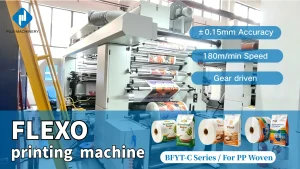
Meta Description: Can a stack flexo press deliver both ±0.15mm registration AND 180m/min on laminated woven bags? Yes. Here’s how gear drive engineering makes it possible — and why it matters for your woven bag production line.
Introduction: The Growing Demand for Premium Woven Bag Printing
The global woven sack market is projected to exceed $14 billion, with polypropylene woven bags dominating the segment. From rice and flour to feed, fertilizer, and chemical packaging — laminated woven bags are the backbone of industrial packaging worldwide.
But as competition intensifies, brand owners are demanding more from their packaging. Printed logos need to be sharper. Barcodes must be scannable. Colors need to match consistently across every batch.
For woven bag converters, this creates a two-sided challenge:
- Precision — Can your press hold registration within ±0.15mm on the slippery, elastic surface of laminated woven fabric?
- Speed — Can it do this at a production speed that keeps your delivery commitments profitable?
Most stack flexo presses on the market today struggle with one or both. Let’s examine why — and how the BFYT-C gear-driven stack press from Puji Machinery (20+ years, 500+ machines across 50+ countries) addresses both.

Why Laminated Woven Bags Are a Printing Challenge
Laminated woven fabric is fundamentally different from standard film or paper. Three characteristics make it particularly demanding:
These three factors compound in a stack-type press, where the web travels through multiple independent printing stations. Without precise engineering, the result is registration drift that starts small — 0.05mm here, 0.1mm there — and accumulates into unacceptable print quality.
Industry Benchmark: What Accuracy and Speed Do Woven Bag Producers Actually Need?
Registration Accuracy Standards
Not all woven bag applications require the same precision. Here’s a practical breakdown:
For rice bags, premium flour packaging, and branded feed sacks — the products that command higher margins — ±0.15mm is the benchmark. Many stack presses fall short, forcing converters to either accept higher waste or invest in expensive CI presses.

Speed Benchmark
Speed is equally critical for woven bag converters operating at scale:
Most entry-level stack presses top out at 100–120 m/min on laminated woven — a speed that’s increasingly insufficient for modern production demands. A machine that runs at 180 m/min delivers 50–80% more output per shift than a 100 m/min press, with the same labor cost.
The Hidden Cost of Inaccuracy and Slow Speed
Industry data paints a sobering picture:
- Registration errors account for nearly 30% of all flexographic printing waste (FTA Waste Reduction Benchmark, 2022)
- A print shop running at 100 m/min with 5% waste versus 180 m/min with 2% waste faces a profitability gap of over 30% in material and labor productivity
- For a converter producing 500,000 bags per month, even a 3% reduction in waste saves thousands of dollars annually
The question is not whether your press can print — it’s whether it can print profitably.
BFYT-C: Engineered for Both Precision and Speed
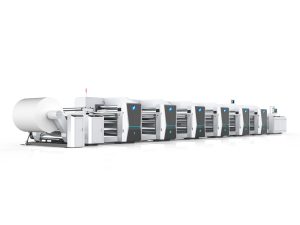
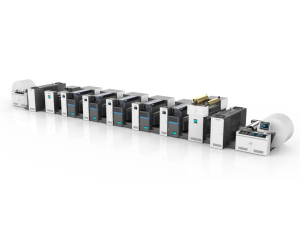
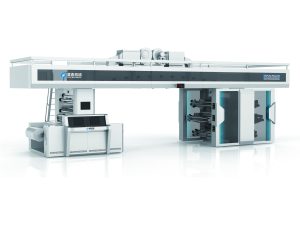
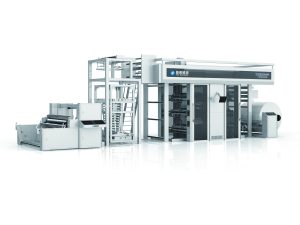
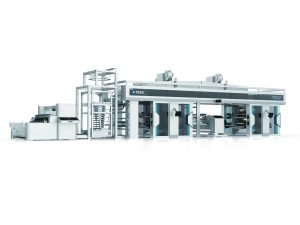
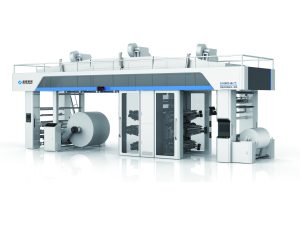
The BFYT-C gear-driven stack flexo press from Puji Machinery is designed specifically to overcome the laminated woven bag challenges described above. Here’s how.

1. Gear Drive — The Foundation of Long-Term Accuracy
Most entry-level stack presses use synchronous belt drive — a cost-effective solution with a significant drawback. Under continuous production load (12-hour shifts, 300 days a year), belts undergo micro-stretching. Over 3–6 months, this accumulated stretch translates into measurable registration drift.
BFYT-C uses gear drive instead.
For woven bag converters running 24/6 production, gear drive is not a premium — it’s a necessity.
2. Thickened Cast Iron Frame — Vibration Damping at Speed
At 180 m/min, vibration is the enemy of precision. Every micro-vibration between the print station and the substrate translates into a blurred dot, a fuzzy edge, a slightly shifted registration mark.
The BFYT-C features thickened cast iron wall panels — a heavier, more rigid frame than typical stack presses in its class. Cast iron naturally damps vibration more effectively than welded steel frames, maintaining print quality at higher speeds without requiring speed reduction.
3. Precision Tension Control — Working With the Material, Not Against It
Laminated woven fabric stretches under tension. The key is controlling that stretch — not eliminating it, but compensating for it dynamically.
The BFYT-C employs:
- High-precision magnetic powder tension control at unwind
- Independent servo-driven rewind with taper tension programming
- Closed-loop tension monitoring between print stations
This system adjusts tension as the roll diameter changes — a critical feature for long runs where tension drift would otherwise accumulate into visible registration shift.
4. Independent Hot-Air Drying Between Stations
Speed is meaningless if the ink hasn’t dried before rewinding.
The BFYT-C features independent hot-air drying at each color station, with drying power configurable for water-based, solvent, and UV inks. This allows the press to maintain 180 m/min without compromising ink cure — a common bottleneck on presses with shared or undersized drying systems.
BFYT-C Key Specifications
Cost Advantage: Stack Press vs CI Press
A common misconception is that achieving both ±0.15mm accuracy and 180 m/min speed requires a CI flexo press — at 2–3× the investment.
For woven bag applications — where ±0.15mm is sufficient and 180 m/min meets production targets — the stack press delivers a significantly faster ROI than a CI press.
20+ Years of Flexo Engineering Expertise
Puji Machinery has been designing and manufacturing flexographic printing presses since 2014, building on an R&D foundation with over 20 years of industry experience. With 500+ machines deployed across 50+ countries and 50+ invention patents, our engineering team understands the specific demands of woven bag production.
Every BFYT-C is backed by:
- ISO 9001:2015 certified manufacturing
- CE certified for export compliance
- SGS verified factory audit
- NSK Japan main bearings for long-term reliability
- Delta Taiwan PLC and touchscreen controls
- Global after-sales support with remote diagnostics and on-site installation available
Conclusion: Precision and Speed — You Don’t Have to Choose
The woven bag market is growing, and the demand for higher print quality is not going backward. For converters who need to stay competitive, the choice is clear:
- Accept the limitations of a belt-driven press and live with higher waste and slower speeds — or
- Invest in a gear-driven stack press that delivers ±0.15mm accuracy at 180 m/min — at a cost that makes financial sense
The BFYT-C gear-driven stack flexo press from Puji Machinery proves that precision and speed are not trade-offs. They’re engineering choices.
Want to see the BFYT-C running laminated woven bags on your floor? Contact our technical sales team for a detailed proposal tailored to your production requirements.
About Zhejiang Puji Packaging Machinery Co., Ltd.
With 20+ years of industry experience, 50+ invention patents, and 500+ machines deployed across 50+ countries, Puji Machinery is a trusted manufacturer of high-performance flexographic printing presses, slitting rewinders, and packaging converting equipment. All machines are ISO 9001:2015 and CE certified.
Tags: laminated woven bag flexo printing, woven bag printing machine, stack flexo press for woven bags, ±0.15mm registration accuracy, gear drive flexo press, BFYT-C stack press, laminated sack printing, high speed flexo press 180m/min, woven sack flexographic printing, industrial bag printing machine